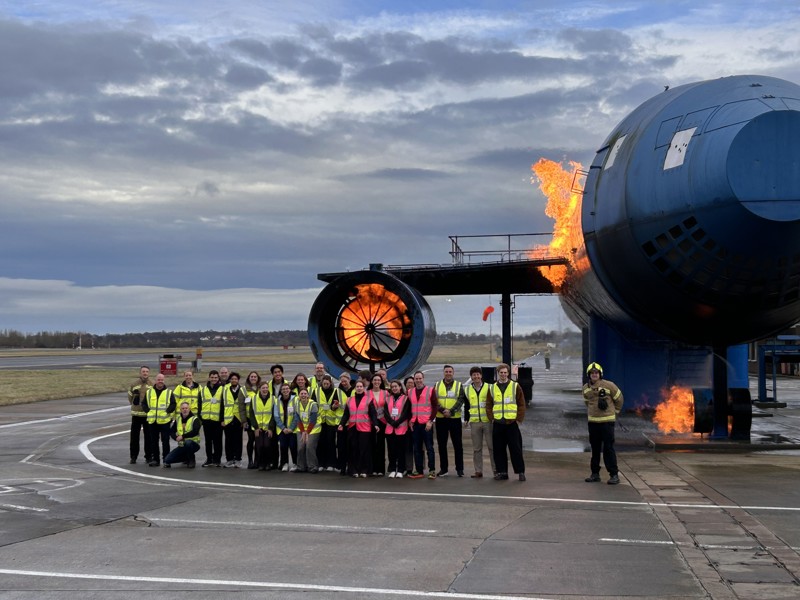
NHS Fife has led a groundbreaking training initiative designed to prepare future clinicians for responding to medical emergencies onboard aircraft.
The innovative full day simulation event took place at Edinburgh Airport, developed and led by Dr Martin Clark, Consultant Anaesthetist and NHS Fife Simulation Lead, Dr Charlotte Reid, NHS Fife Clinical Teaching Fellow and NHS Fife Medical Education Staff.
It is believed the training marks the first time a medical education programme in the UK has collaborated directly with an airport to deliver immersive, aviation based clinical training.
The programme, created for senior medical students, exposed learners to realistic medical scenarios they may encounter as bystanders during commercial flights, including inflight medical emergencies.
The aim was to build confidence, clinical reasoning and situational awareness in environments outside traditional NHS settings.
In a unique collaboration learning experience, Edinburgh Airport Fire Service gave access to the airport’s training rig, with Jet2 providing an aircraft and their cabin crew for further simulation training for the students.
This level of immersive, cross agency training bringing together NHS clinicians, airport emergency responders and airline cabin crew is also believed to be the first of its kind in the UK.
A total of 16 final year St Andrews University students (as part of the ScotGEM programme) and Dundee University students took part and following evaluation, NHS Fife’s Medical Education team plan to share learning, training materials and expertise to help promote innovative medical education practices more widely.
Hanna Akel, NHS Fife Simulation Centre Manager, said: “This landmark training event gave our students a unique chance to learn and use their skills. Everyone involved, from the NHS Fife simulation team who were there on the day to the students themselves got so much from the opportunity.
“We’d like to extend our thanks to Edinburgh Airport staff, the Fire and Rescue Service at the airport and Jet2 for giving their time and facilities to us, it was a day we wont forget and are very grateful to have had the opportunity.”
Dr Charlie Reid, NHS Fife Scotgem Teaching Fellow, said: "GMC Good Medical Practice says doctors must offer assistance in emergencies if they are able to do so being mindful of their own safety, competence and the availability of other options of care.
“We don't have any training for out of hospital situations in medical school. One of the most daunting scenarios is being on a plane because there's no equipment, no internet and no ability to phone for help. I wanted to develop this training simulation to prepare medical students for potential clinical scenarios they may face during their career outside of their NHS role.
"I had this experience once, when the cabin crew asked if there was a doctor on board when I was on a flight to Tenerife. You obviously want to help but it puts you in an uncomfortable, unfamiliar position.
“Once you start talking to doctors about this, everyone has a story and the common theme was uncertainty. I wanted to improve medical student’s confidence to offer assistance once they become doctors.
"This week's landmark training simulation event helped us test the concept and we hope now to expand the idea to incorporate other learners, students and scenarios. We are proud that NHS Fife through the ScotGEM programme, is leading the way and we would of course be happy to share this experience, our learning and our scenarios with other Boards in the future."
Peter Barnes, Chief Operations Officer at Edinburgh Airport, said: “Opening up aircraft and the airport to this kind of hands-on learning is not something we do every day, and it’s been brilliant to see how much the students gained from it.
“This is the first time we’ve collaborated on a medical training exercise of this scale, and we’re really proud to have played a part in bringing partners together to create practical experiences that future doctors can learn from.”
ENDS
Notes to Editors:
[ENDS]